
Ebbinghaus curve or the forgetting curve
What the forgetting curve is and how to use it
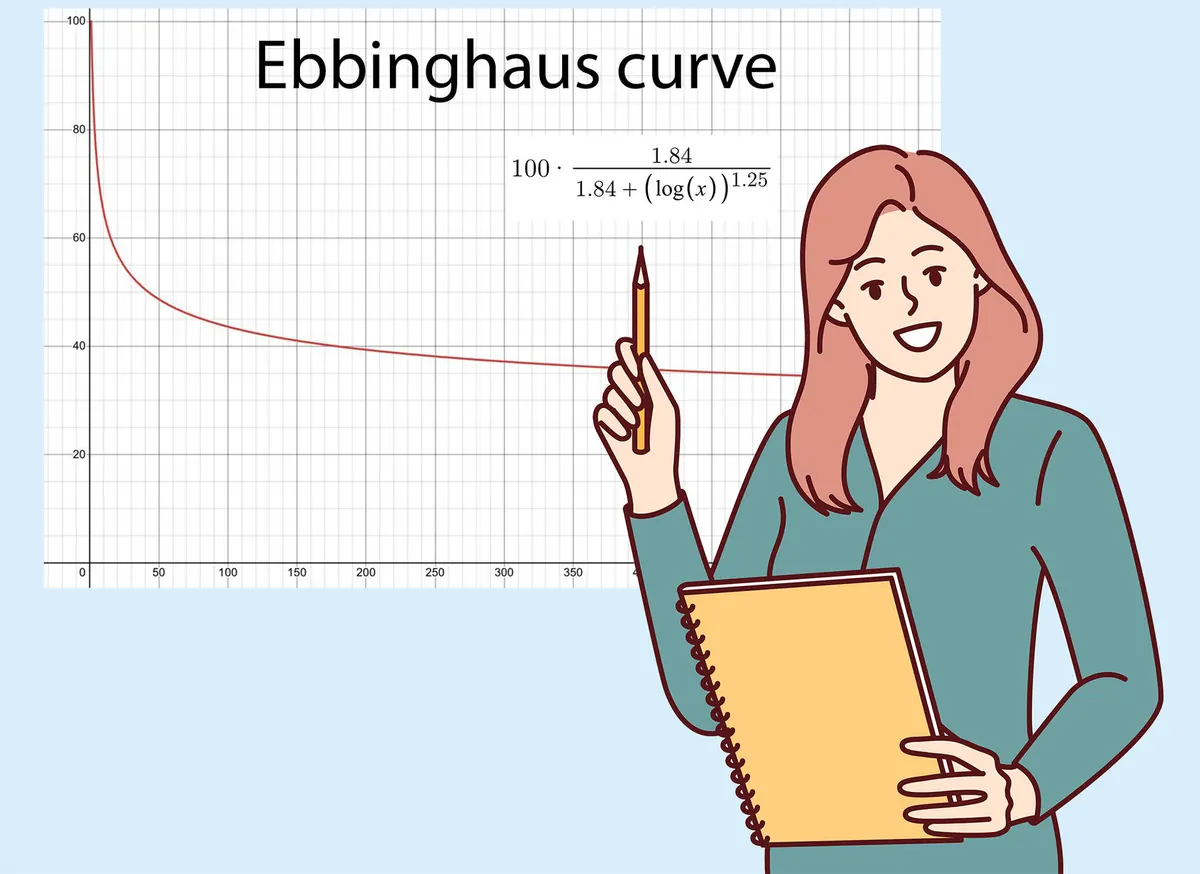
Any ideas left to themselves are gradually forgotten.
History and theory
What is the forgetting curve?
People tend to forget new information twice as fast as older information if they do not deliberately review what they have learned.
The forgetting curve shows how information stays in memory over time when no attempt is made to refresh it. A typical forgetting-curve chart shows that people tend to forget new information twice as fast as older information if they do not deliberately review what they have learned.
In 1885, Hermann Ebbinghaus published Über das Gedächtnis (“On Memory”) in Berlin. In 1913 the work was translated into English and published in New York as Memory. A contribution to experimental psychology. Ebbinghaus devised a method for precise, quantitative, and objective measurement of higher mental processes.
What method did Hermann Ebbinghaus use?
Ebbinghaus studied the memorization of sequences (series) of nonsense syllables — for example, “WID” and “ZOF” (consonant–vowel–consonant) — repeatedly testing himself after various intervals and recording the results. In that work he investigated:
- How quickly series of syllables are learned depending on series length;
- Retention as a function of the number of repetitions;
- Retention and forgetting as functions of time;
- The effect of intervals between repetitions;
- The effect of an item’s position in the series;
- The effect of associations on memorization;
He plotted how retention depends on time on a graph now known as the “forgetting curve.”
Chart and formula
The forgetting curve
The chart is plotted strictly from Ebbinghaus’s formula
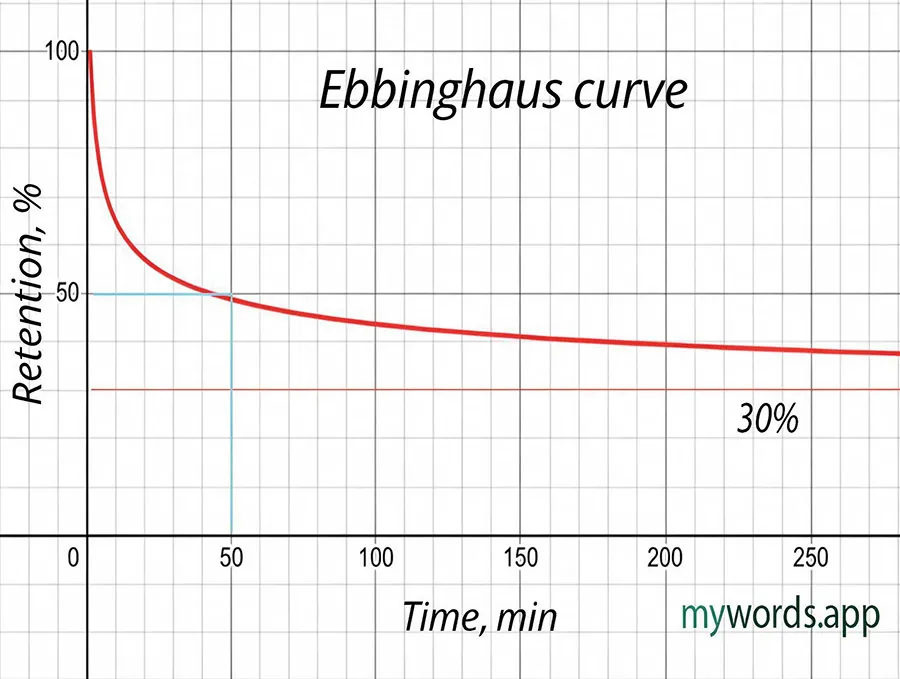
The Ebbinghaus curve plotted from Ebbinghaus’s formula
It was striking to find that forgetting is very rapid at first and then slows over time. Without review, roughly one third of the information remains in memory.
Ebbinghaus noted with some surprise that forgetting is very rapid at first and then slows over time. An hour after learning, half the original work was needed to restore the series to memory. After eight hours, two thirds of the original work was required. Remarkably, after both 24 hours and six days, about one third of the information still remained in memory.
He also derived an empirical formula that roughly describes the forgetting curve:
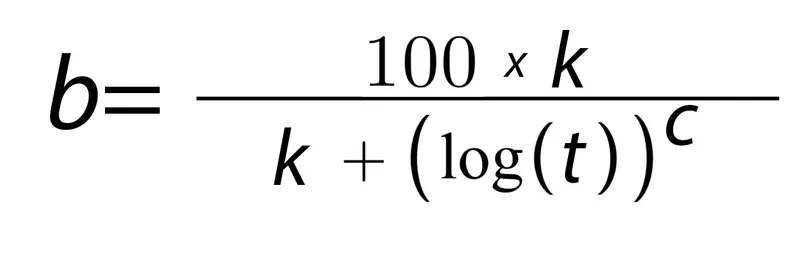
Ebbinghaus’s formula as given in On Memory
- t
- time in minutes, counted from the end of learning minus one minute
- b
Savings — “the saving of work required for relearning”: the share retained on the first attempt, as a percentage of the original learning time. Savings of 100% means all items are still known; 75% means relearning would take 75% less time. So “savings” is close to a retention coefficient. Thus b can be read as “remembered information,” expressed as a percentage.
- K, C
constants K = 1.84 and C = 1.25, chosen so the formula matches the experimental data as closely as possible
The forgetting curve makes clear that the greatest effect comes from:
- More intensive learning of the material at the very start;
- Reviewing the information within 24 hours.
Practice
How to apply Ebbinghaus’s findings
Hermann Ebbinghaus suggested that the rate of forgetting depends on several factors, such as:
- the difficulty of the material;
- how meaningful it is;
- physiological factors such as stress and sleep.
He also suggested that the baseline rate of forgetting differs little from person to person and that differences can be explained by mnemonic skill. He further hypothesized that basic training in mnemonic techniques can partly close those gaps.
He argued that the best methods for remembering are:
- improving how information is represented in memory (for example, with mnemonic methods).
- repetition based on active recall.
- repetition spaced over time (spaced repetition).
The forgetting curve shows that each review lengthens the optimal interval before the next review is needed. Near-perfect retention may require reviews over several days; later, reviews can be spaced years apart.
Ebbinghaus found that information is easier to remember when it builds on what you already know and that the forgetting curve flattens with each review. That is the basis of spaced repetition.
Source: Hermann Ebbinghaus, “Memory. A contribution to experimental psychology”. Teachers College, Columbia University, New York City, 1913.