
Spaced repetition — a method for remembering for good
An effective way to memorize foreign words, poems, texts, formulas and dates
Ideas left to themselves are gradually forgotten.
History and theory
Why spaced repetition matters
When the method works best
Spaced repetition is typically used when you need to memorize many pieces of information and keep them in memory for a long time.
Spaced repetition is an effective way to memorize new information. It works especially well for:
- learning foreign words and growing your vocabulary;
- memorizing poems and multiplication tables;
- remembering historical dates;
- learning formulas and rules;
- training memory and more.
Although the method helps in many contexts, spaced repetition is most often used when someone must absorb a large number of items and retain them long-term.
How the Ebbinghaus curve supports the method
Spaced repetition was first grounded by Hermann Ebbinghaus in 1885 in Memory: A Contribution to Experimental Psychology. In that research he:
- discovered a law describing how information is forgotten over time;
- plotted a graph later known as the Ebbinghaus forgetting curve;
- showed that information sticks better when you do not study continuously, but pause and review at set intervals.
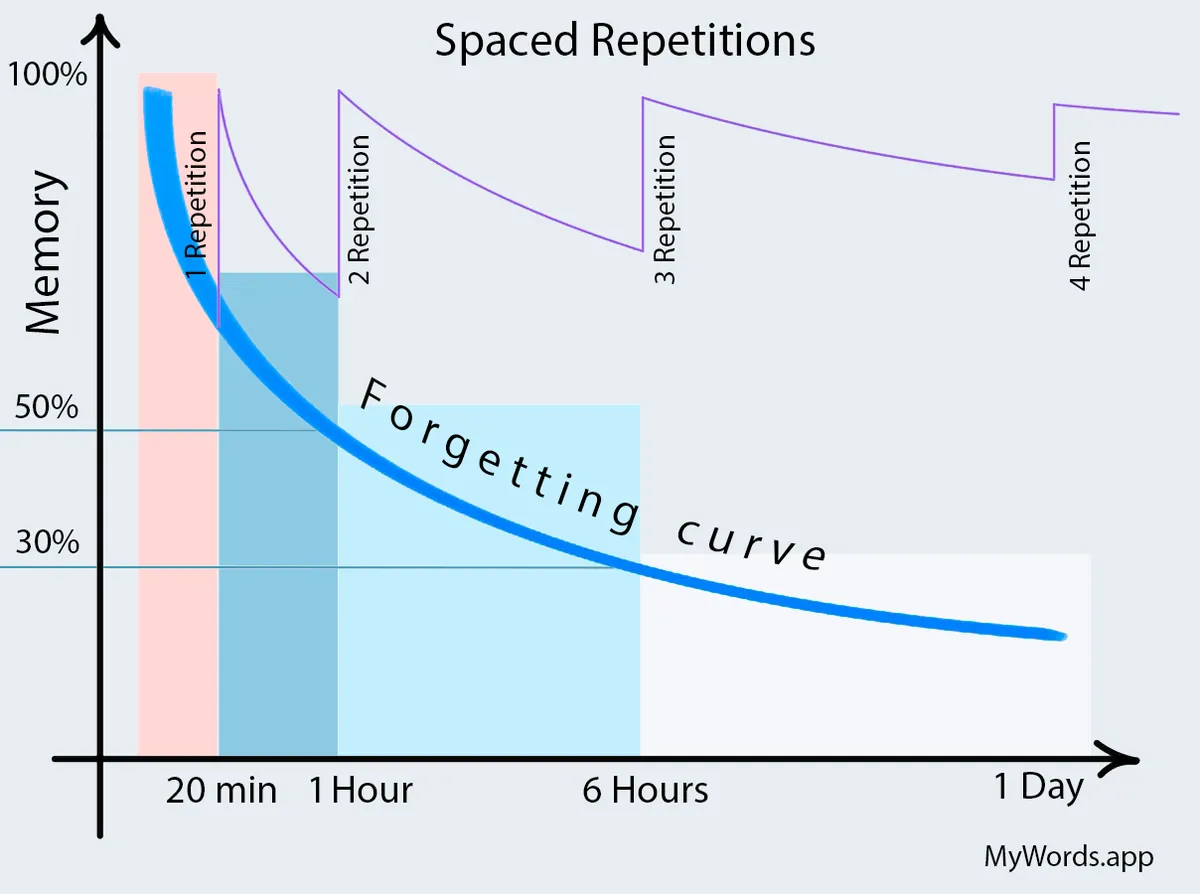
Setting review intervals from the Ebbinghaus curve
Ebbinghaus found that information is easier to remember when it builds on what you already know, and that the forgetting curve flattens with each review.
The rate of forgetting is not constant — it is highest in the first hour. Within about 6 hours, up to 70% of new information can be lost. After that, forgetting slows (the curve flattens), and as little as 20% may remain in memory for several more days.
Each review brings retained information back up to 100%.
The method
How to use spaced repetition
What should the intervals be?
- Learn a block of information.
- Do the first review after a short gap following the initial study. It should be under 20 minutes — ideally after 1–2 minutes. Forgetting is very fast in this window. Because the gap is short, the brain has not forgotten much yet, and a successful recall gives positive reinforcement.
Review should not be passive. You need to retrieve the information from memory — for example by saying it aloud or using quiz-style exercises.
- Schedule the second review within the first hour. As the interval grows, the brain has to work harder to retrieve the information. That deeper processing helps move it into long-term memory, where forgetting is slower.
- Later reviews use still longer gaps. To lock information in for good, review after a few days, then weeks, then months.
- Review should not be passive. Retrieve the information from memory — for example by saying it aloud or using quiz-style exercises.
Further development
Spaced repetition combined with the Leitner method
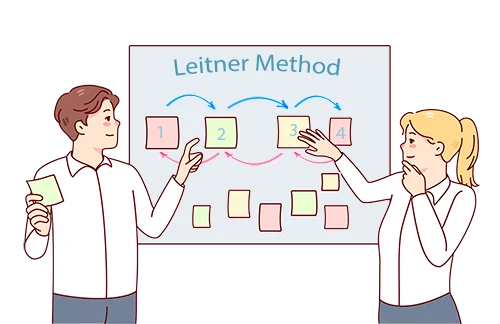
Spaced repetition can be combined with the Leitner method — learning with flashcards.
Interestingly, Ebbinghaus’s research was not put into everyday practice until about a century later. Spaced repetition can be paired with the Leitner method — studying with flashcards. That system was proposed in 1972 by German journalist and science popularizer Sebastian Leitner.
Write what you need to learn on cards: a question on the front, the answer on the back. Cards can sit in several boxes — for example, boxes one through five.
The learner picks a card and tries to answer the question on the front. On a correct answer, the card moves to the next box; on an incorrect one, it moves back. At the start, all cards are in the first box.
As a result, harder cards appear more often, while older, easier cards appear less often.
Spaced repetition in the My Words app for learning vocabulary
Our app includes an advanced algorithm for learning foreign words. On the Learn tab, simply choose Smart mode.
My Words combines spaced repetition with the Leitner method for fast, effective vocabulary learning. You can add words from books, videos, or your own lessons, or import a list. Practice in different ways — with flashcards, dictations, exercises, or listening on the player. Learn more…
Spaced repetition beyond language learning
Spaced repetition can help not only students, but also people with memory impairments.
In the 1980s, researchers began studying spaced repetition with people who had amnesia and other memory disorders. The results showed that spaced repetition can help not only students, but also patients with memory impairments.
Later studies found that using this method with people who have Alzheimer’s disease can lengthen how long certain information stays in memory. These findings show that gradually increasing the gap between reviews has a strong positive effect on memory.
Recent research has also shown that a spaced approach works not only for memorizing information, but also for solving complex math problems.