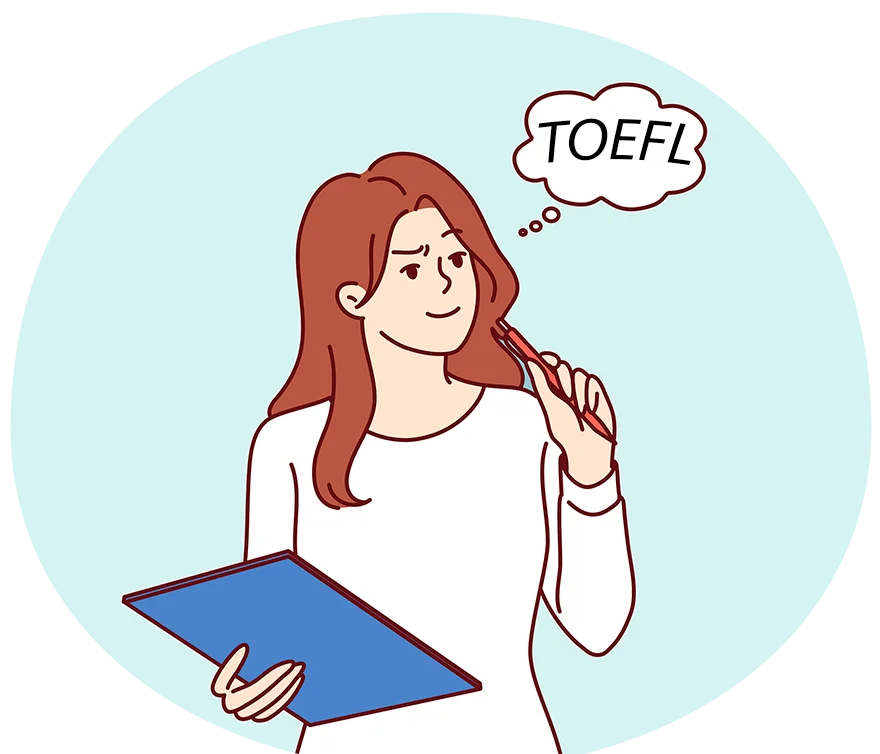
TOEFL (Test of English as a Foreign Language) is a standardized exam that measures English proficiency for people who are not native speakers. A defining feature of the test is its focus on academic English rather than everyday conversation — one of the main differences between TOEFL and IELTS.
A TOEFL score is valid for 2 years. The test is widely recognized and used by more than 11,000 universities and other educational institutions in many countries to assess English proficiency for applicants and students.
Who runs it? Where can you take it?
TOEFL is developed and administered by Educational Testing Service (ETS). You can take the test from home on your own computer. The certificate is valid for 2 years and is widely accepted by more than 11,000 universities and other educational institutions in the United States and many other countries when evaluating applicants’ and students’ English proficiency.
TOEFL versions: iBT and others
There are several versions of the TOEFL test:
Paper-based Test (PBT) — the paper version, which is no longer offered;
Internet-based Test (iBT) — the online version and the most common one; you can register at ets.org;
TOEFL Essentials — a shorter version for assessing a basic level of English;
TOEFL iTP — a version used in certain regions without reliable internet access.
TOEFL exam sections
Four TOEFL sections: Reading, Listening, Speaking, and Writing
Reading
30–40 questions 35 minutes
The Reading section includes 3–4 excerpts from academic texts, each about 700 words. The passages cover topics you would typically find in a university textbook.
What you need to do:
Facts: identify what is and is not stated in the text
Inferences and rhetorical purpose: understand what the author meant and why they wrote it
Vocabulary: know the meaning of common academic words and phrases
Sentence simplification: choose a shorter version that preserves the meaning of the original
Insert text: place a sentence in the most appropriate spot in a paragraph
Summary: choose three statements that capture the main idea of a paragraph
Listening
28 questions 36 minutes
In the Listening section you hear excerpts from lectures and discussions. There are 3 lectures of 3–5 minutes each (some include discussion), with 6 questions per lecture, plus 2 conversations of about 3 minutes each, with 5 questions per conversation. You may take notes while listening. Speakers may have British, New Zealand, Australian or American accents.
What you need to do:
Comprehension: grasp the main content and purpose of the lecture
Details: pick out specific facts
Context: understand what a phrase means in a given situation
Attitude: recognize how the speaker feels
Organization: understand why the lecture is structured the way it is
Logical connections: predict outcomes, draw conclusions, and follow cause-and-effect relationships
Inference: identify information that is implied rather than stated directly
Speaking
4 tasks 16 minutes
The Speaking section measures how effectively you can talk about academic topics. You get 15–30 seconds to prepare and 45–60 seconds to respond. You speak into a microphone, and your answers are recorded.
Question 1: independent speaking task — you rely only on your own ideas, opinions, and experience.
Questions 2–4: integrated speaking tasks — you combine English skills — listening and speaking, or listening, reading, and speaking — much as you would in a classroom.
Writing
2 tasks 30 minutes
The Writing section tests your ability to write in an academic style and express ideas clearly and in an organized way.
You complete two tasks:
Integrated writing task (20 minutes) — read a short passage and listen to a short lecture, then write a response.
Writing for an academic discussion (10 minutes) — share your opinion in an online discussion with a professor and other students.
How do TOEFL results map to the familiar A–C proficiency levels?
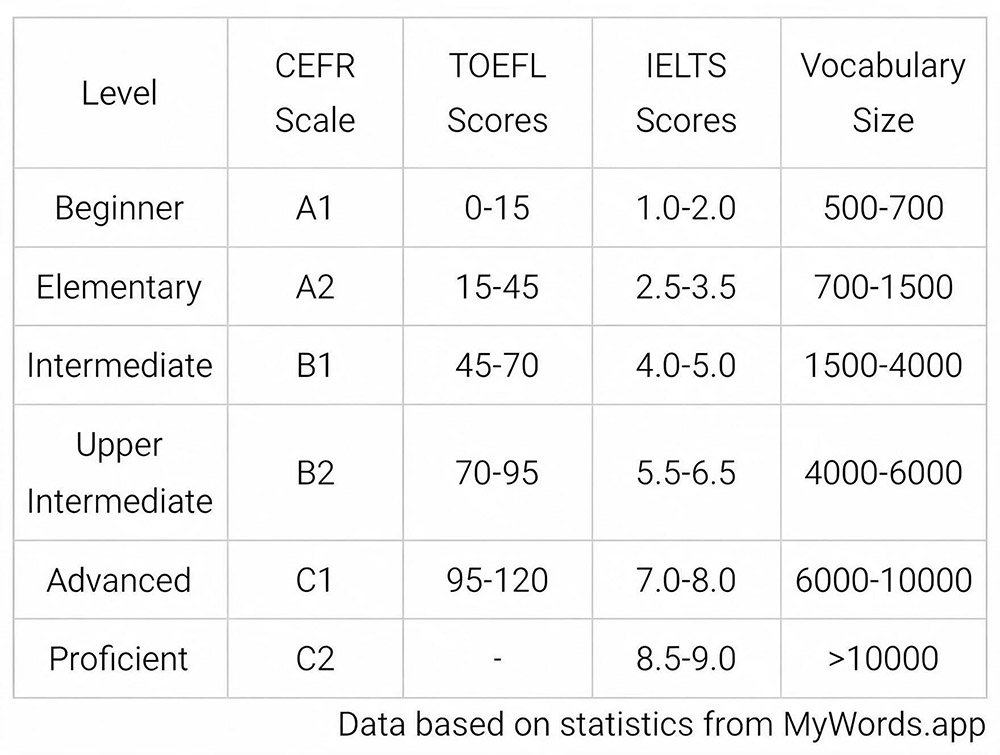
We put together an approximate mapping between English proficiency level, IELTS scores, TOEFL scores and vocabulary size. The data is in the table below. For example, a TOEFL iBT score of 100 can roughly correspond to CEFR level C1.
TOEFL does not classify results by English levels such as A, B, and C under the Common European Framework of Reference for Languages (CEFR). Still, we put together an approximate mapping between English proficiency level, IELTS scores, TOEFL scores and vocabulary size. The data is in the table below. For example, a TOEFL iBT score of 100 can roughly correspond to CEFR level C1.
TOEFL scores range from 0 to 120. Most institutions look for roughly 60–100, though requirements vary by school and program.
One distinctive feature of TOEFL is that a native speaker may not score a perfect 120, while someone who is not fully fluent can still earn a high score. That is because TOEFL focuses on academic language and topics, not everyday conversation. So a maximum TOEFL score does not mean CEFR C2 proficiency.
Table of TOEFL scores, language levels, and vocabulary size
How large a vocabulary do you need for TOEFL?
There is no official vocabulary-size requirement for TOEFL, but in our data a score of 100 roughly corresponds to a vocabulary of 6,000–7,000 words.
To do well on TOEFL, you need enough vocabulary to understand a wide range of texts and complete listening tasks. There is no official vocabulary-size requirement, but in practice a TOEFL score of 100 often corresponds to a vocabulary of about 6,000–7,000 words.
You can also use these guidelines:
Reading comprehension: know the words and expressions needed to grasp the overall meaning of texts — everyday vocabulary as well as academic terms and concepts.
Listening: understanding spoken English requires everyday words and phrases plus terms linked to academic subjects.
Writing: essays and other written tasks call for words and structures that let you express ideas and support a point of view.
Speaking: communicating in English means knowing a wide range of words and phrases to express different thoughts and feelings.
To prepare for TOEFL, study high-frequency word lists, academic vocabulary, and common scientific terms — and practice reading, listening, writing, and speaking.
Yes, we use cookies too — analytics helps us improve. Privacy Policy
Choose whether optional analytics cookies may be used. Essential cookies needed for the site to work are always on. Privacy Policy
Analytics cookies
Help us understand site usage with Yandex Metrica (page views and interaction data). Off by default.